Your Marketing Stack Is Bleeding Money—Integration Debt Is the Silent Profit Killer
I've spent years looking at marketing stacks, and I keep seeing the same pattern.
Companies spend millions building their tech ecosystems. They add tools for email, CRM, analytics, automation, advertising, content management. Each purchase makes sense in isolation. Each vendor promises seamless integration.
Then reality hits.
The tools don't talk to each other. Data lives in silos. Your team spends hours manually moving information between systems. Leads fall through cracks. Attribution becomes guesswork. And every quarter, you're paying for capabilities you can't actually use.
This is integration debt—the hidden tax on every disconnected tool in your marketing stack.
The numbers tell a story most executives don't want to hear. Data silos cost the global economy $3.1 trillion annually. Bad data costs individual companies $12.9 million per year. And up to 23% of marketing budgets vanish into poorly attributed activities where you can't identify what actually drives results.
You're not just losing efficiency. You're losing money.
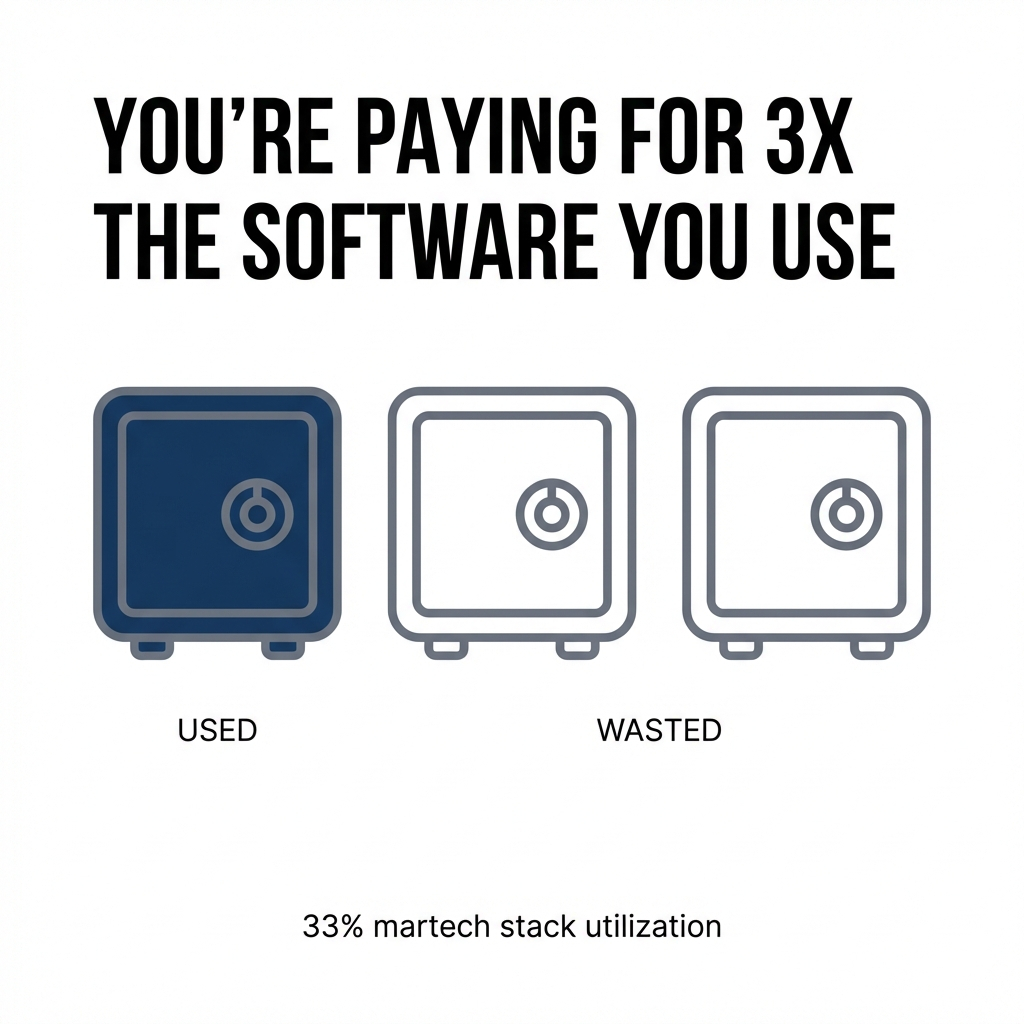
The Utilization Crisis: Paying Triple for What You Use
Here's what keeps me up at night.
The typical enterprise now uses only 33% of their martech stack capability. Read that again. You're paying for three times the software you actually use.
This isn't about lazy teams or poor training. This is a structural problem.
When your CRM doesn't sync with your marketing automation platform, you can't use the lead scoring features you paid for. When your analytics tool can't pull data from your ad platforms, those attribution models sit unused. When your content management system doesn't integrate with your email platform, you manually export and import everything.
60% of martech projects miss their ROI expectations. At least 30% of tools in your stack are either redundant, underutilized, or actively creating dirty data that makes everything worse.
I've watched companies buy enterprise software packages, implement maybe a third of the features, then buy another tool to fill gaps that the first tool was supposed to handle. The problem wasn't the tool. The problem was integration debt piling up faster than anyone noticed.
The Real Cost: Time, Revenue, and Sanity
Let me show you what integration debt actually looks like in practice.
Your marketing team wastes 12 hours per week hunting for data trapped in disconnected systems. That's 29% of their time. Not strategizing. Not creating. Not optimizing. Just searching for information that should be at their fingertips.
Your sales team spends only 16% of their workday engaging with customers. The rest? Administrative work, data entry, and trying to figure out which leads are actually qualified.
Almost 79% of leads never convert because they aren't properly followed up with. And 61% of marketers pass leads straight to sales without proper qualification. This isn't a people problem. This is what happens when your marketing automation platform doesn't seamlessly hand off qualified leads to your CRM with complete context.
The average company now uses nearly 300 SaaS tools with annual costs exceeding $50 million. But integration issues consume the value.
When I talk to marketing leaders, they all say the same thing: "We know we're not getting full value from our stack." Then they describe the workarounds their teams have built. The spreadsheets. The manual data transfers. The weekly reconciliation meetings.
These aren't solutions. These are symptoms of integration debt compounding.
Why Integration Became the Number One Barrier
The martech landscape has exploded to over 15,000 tools in 2025.
Every vendor promises to solve a specific problem. Most deliver on that promise in isolation. But marketing doesn't happen in isolation.
You need your ad platforms talking to your analytics. Your CRM syncing with your marketing automation. Your content management system feeding your email platform. Your attribution model pulling from every touchpoint.
66% of companies can't measure the effect of their systems because of challenges in data infrastructure and stack integration. Think about that. Two-thirds of organizations have no idea if their marketing technology actually works.
Integrations are now the number one factor behind switching martech software. Not features. Not price. Integration capability.
I've seen companies abandon perfectly good tools because they couldn't make them work with the rest of their stack. The tool wasn't the problem. The ecosystem was broken.
75% of RevOps professionals flag data inconsistencies as their biggest challenge. When your customer data lives in five different systems with five different versions of the truth, you can't build reliable processes. You can't forecast accurately. You can't optimize effectively.
The Technical Debt Compound Effect
Here's where it gets worse.
Integration debt compounds like financial debt. Every new tool you add increases the complexity exponentially. Every workaround becomes a dependency. Every manual process becomes a bottleneck.
20% to 40% of IT budgets now go toward maintaining technical debt. Companies with 20+ tools spend 40% of their martech budget just on integration issues. You're spending nearly half your budget making tools talk to each other instead of using those tools to grow revenue.
Enterprises waste up to 40% of their tech budgets maintaining outdated systems that can't integrate with modern platforms. You can't rip and replace everything, so you build bridges. Then you maintain the bridges. Then you build bridges between the bridges.
I've watched this spiral consume entire IT departments.
The Revenue Leakage Nobody Talks About
Integration debt doesn't just waste money on unused software and IT overhead.
It bleeds revenue.
85% of companies acknowledge that decisions based on stale data lead to incorrect conclusions and lost revenue. When your data takes hours or days to sync between systems, you're making decisions on yesterday's information in a market that moved this morning.
55% of US marketers believe that a poorly integrated martech environment has directly resulted in lost revenue for their business. This isn't speculation. This is measured impact.
Here's what revenue leakage looks like:
Qualified leads that never get followed up because they didn't sync to the CRM
Customers who churn because marketing and customer success aren't sharing data
Ad spend that continues on underperforming campaigns because attribution data is delayed
Upsell opportunities missed because product usage data doesn't flow to sales
Personalization that fails because customer behavior across channels isn't unified
Every gap in your integration creates a gap in your revenue.
I've seen companies lose six-figure deals because their sales team didn't have visibility into marketing engagement. The data existed. It just lived in a system the sales team couldn't access in real time.
What Good Integration Actually Looks Like
The companies that get this right see dramatically different results.
Marketing leaders are twice as likely to have a fully mature marketing technology stack. They're two times more likely than laggards to actively integrate and leverage tools for measurable impact.
Organizations implementing strategic, well-integrated martech stacks see a 20% to 40% increase in marketing ROI. This isn't marginal improvement. This is transformational.
But here's what surprises people: good integration isn't about having fewer tools or spending less. It's about making sure every tool in your stack can share data bidirectionally, in real time, without manual intervention.
When your systems actually talk to each other:
Your marketing team spends time optimizing campaigns instead of hunting for data
Your sales team has complete context on every lead before the first call
Your attribution models actually reflect reality because they pull from every touchpoint
Your automation works because triggers fire based on unified customer data
Your reporting tells a coherent story because all your data sources align
This is what you paid for when you bought all those tools. Integration debt is what prevents you from getting it.
The Audit You Need to Run Tomorrow
Most companies don't know how much integration debt they're carrying.
You need to audit your stack with brutal honesty. Here's what to look for:
Tool utilization: For each platform in your stack, what percentage of paid features do you actually use? If it's under 50%, ask why. Often the answer is integration gaps.
Manual processes: Where does your team manually move data between systems? Every manual export/import is integration debt.
Data inconsistencies: Pick a customer record. Check how their data appears across your CRM, marketing automation, analytics, and support platforms. If you see different versions of truth, you have integration debt.
Time waste: Track how much time your team spends searching for data, reconciling reports, or waiting for information from other systems. This is the hidden cost.
Failed handoffs: How many leads get lost between marketing and sales? How many customer issues fall through cracks between teams? Integration debt creates these gaps.
Nearly half of RevOps professionals rate their stack's ROI as average or worse. None of the Fortune 500 CMOs interviewed in recent research could quantify the ROI of their martech investments.
You can't improve what you can't measure. And you can't measure what isn't integrated.
The Path Forward: Strategic Integration
Fixing integration debt isn't about ripping out your entire stack and starting over.
It's about strategic decisions on where integration matters most and what tools actually earn their place in your ecosystem.
Start with your core revenue path. Map every touchpoint from first awareness to closed deal to renewal. Identify where data needs to flow between systems. Prioritize integrations that directly impact revenue generation and customer retention.
Some tools need deep, bidirectional integration. Others just need to export clean data. Know the difference.
Consider integration platforms that can connect multiple tools without custom development for each pair. The right middleware can dramatically reduce your integration debt while increasing flexibility.
But here's the hard truth: you probably have tools that can't be integrated effectively. They're creating debt that compounds every quarter. Sometimes the right answer is to replace them with platforms that play well with your ecosystem.
The companies winning in 2025 aren't necessarily using fewer tools. They're using tools that integrate cleanly, share data freely, and create a unified view of the customer across every touchpoint.
Stop Accumulating Debt, Start Building Value
Integration debt is the silent profit killer because it's invisible on your balance sheet.
You see the software costs. You don't see the opportunity cost of disconnected systems. You don't see the revenue that leaked through integration gaps. You don't see the strategic decisions made on incomplete data.
But your competitors who solve this problem will leave you behind.
The difference between marketing organizations that drive measurable growth and those that struggle to prove value often comes down to one thing: whether their technology actually works as a system or just exists as a collection of disconnected tools.
Your marketing stack should multiply your team's effectiveness. If it's not doing that, you're carrying integration debt.
And that debt is costing you more than you think.
If you're ready to take control of your content distribution and stop letting disconnected systems waste your marketing efforts, check out PressMaster.ai—a platform built to help you distribute thought leadership content efficiently across channels without the integration headaches.
The tools you already paid for can deliver the value you expected. But only if they can actually talk to each other.
Start there.


Comments
Post a Comment