The Death of the Marketing Funnel: Why Linear Customer Journeys Are Business Fiction
I've spent years watching marketers cling to the funnel like it's gospel.
Awareness at the top. Consideration in the middle. Conversion at the bottom. Clean. Sequential. Predictable.
Except none of that reflects how people actually buy anymore.
The traditional marketing funnel assumes customers move in a straight line from discovery to purchase. They don't. They jump between channels, self-educate through digital content, and engage with sales late or not at all. Boston Consulting Group put it plainly: digital transformation has fractured consumer journeys into unpredictable, nonlinear patterns.
And yet we keep building campaigns around a model that treats 2025 like it's 1995.
The Numbers Don't Lie
Here's what happens when you force modern buyers into an outdated framework.
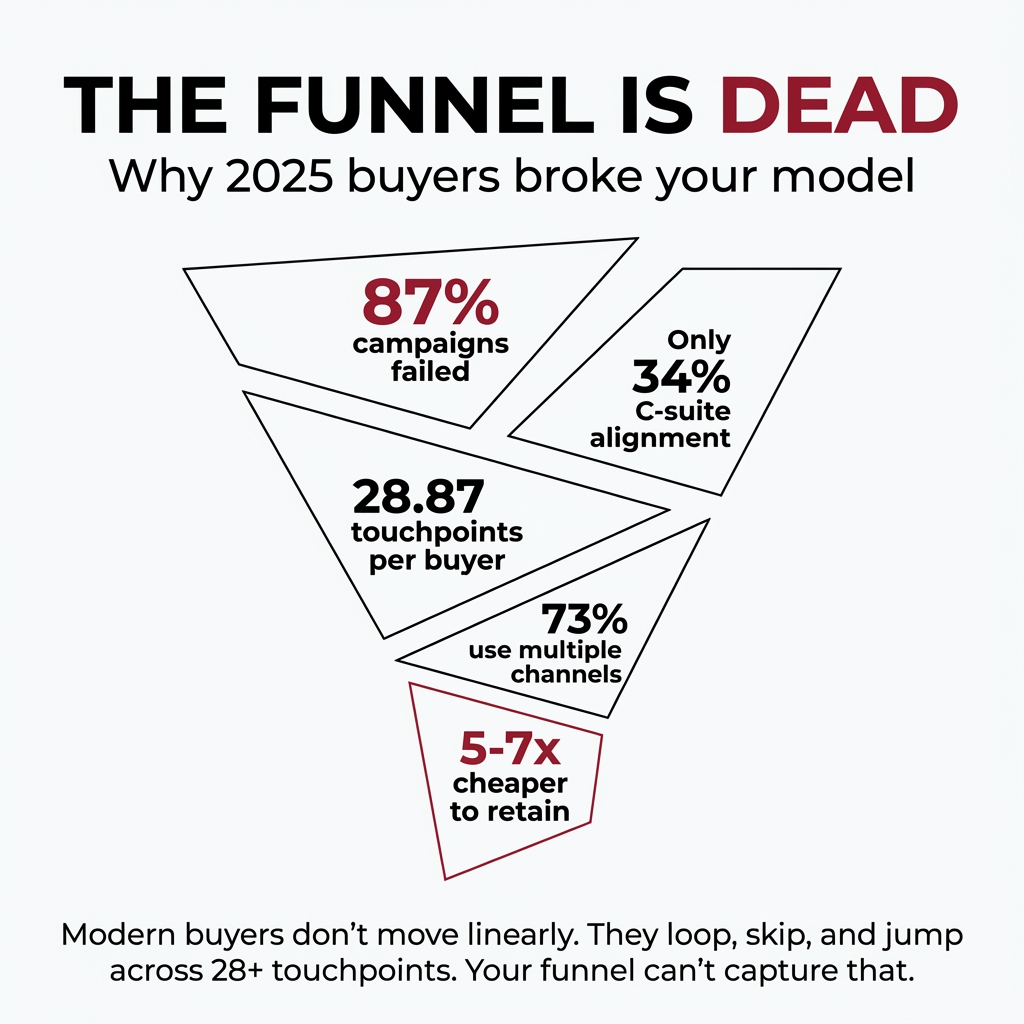
87% of marketing leaders experienced campaign performance issues in 2024. Over half reported problems across every stage of the customer journey. Nearly 45% had to cut campaigns short because results didn't materialize.
That's not a minor hiccup. That's systemic failure.
When your mental model assumes buyers move neatly from awareness to consideration to decision, you build campaigns that miss where people actually are. You create content for a stage they've already passed or haven't reached yet. You optimize for a journey that exists only in your CRM dashboard.
The result? Wasted budget. Missed opportunities. And a growing gap between what marketing promises and what it delivers.
The C-Suite Knows Something's Broken
The disconnect isn't just operational. It's strategic.
Only 34% of CEOs and CFOs align with their CMO on how marketing actually supports growth. Just 22% of executives have clarity on what marketing is accountable for. And only 38% believe their CMO collaborates effectively across the leadership team.
Even more revealing: among CMOs who met or exceeded all their objectives, fewer than half were rated as exceeding CEO and CFO expectations.
You can hit your numbers and still fail to demonstrate value.
Why? Because the funnel creates a language barrier between marketing and the rest of the business. While marketing talks about MQLs and funnel stages, leadership wants to understand revenue impact and customer lifetime value. The funnel measures activity. The business measures outcomes.
That gap isn't semantic. It's existential.
How People Actually Buy
Let me show you what a real customer journey looks like in 2025.
Someone sees your brand mentioned in a podcast. Three weeks later, they search for a solution and land on a competitor's comparison page. They read a Reddit thread about your product. They watch a YouTube review. They sign up for your newsletter but don't open it for two months.
Then they attend a webinar, download a guide, ghost you for six weeks, and suddenly show up ready to buy after talking to a peer at a conference.
The average buyer encounters 28.87 touchpoints before making a purchase decision. That number varies widely by industry and customer value, but the pattern holds: modern buying is messy, non-sequential, and impossible to predict with funnel logic.
And here's the kicker: 73% of retail shoppers use multiple channels throughout their journey. They don't move through your funnel. They move through their life, encountering your brand in fragments across different contexts.
Every channel is simultaneously an opportunity to deepen connection and a risk of losing it entirely.
The Funnel's Fatal Flaw
The traditional funnel has a beginning and an end.
Awareness starts it. Purchase ends it.
But that's not how businesses grow anymore. Retaining a customer is 5 to 7 times cheaper than acquiring a new one, yet the funnel treats post-purchase as an afterthought.
In today's economy, customer retention, loyalty, and advocacy drive sustainable growth. The funnel ignores all of it. It's optimized for acquisition and blind to the reality that your best marketing asset is the customer who already bought from you.
You spend thousands getting someone through the funnel, then act like the relationship ends at checkout.
That's not marketing. That's expensive lead generation with no follow-through.
What Replaces the Funnel
I'm not suggesting you abandon structure. I'm suggesting you abandon fiction.
Modern customer journeys look more like networks than funnels. People enter at multiple points, loop back, skip stages, and influence each other in ways your attribution model will never capture.
Here's what works better:
Signal-based marketing. Instead of pushing people through predetermined stages, you respond to signals of intent and context. Someone downloads a pricing guide? That's a signal. Someone visits your careers page? Different signal. Someone mentions your competitor in a LinkedIn post? Another signal entirely.
You build systems that recognize these signals and respond appropriately, regardless of where someone "should" be in a funnel.
Multi-channel orchestration. You stop treating channels as funnel stages and start treating them as layers of engagement. Email, social, search, events, community—they all work simultaneously, not sequentially. Your job is to maintain coherent presence across all of them.
Outcome-focused measurement. Instead of tracking funnel progression, you measure business impact. Revenue influenced. Customer lifetime value. Time to value. Retention rates. Metrics that matter to the people who sign your budget.
Tools like PressMaster.ai help you create the consistent, high-quality content needed to maintain presence across these multiple touchpoints without burning out your team.
The Practical Reality
You can't change your entire marketing operation overnight.
But you can start questioning the assumptions baked into your current approach.
Next time you build a campaign, ask: am I designing this for how people actually buy, or for how my funnel says they should buy?
When you review performance, look beyond stage-to-stage conversion rates. What signals are you seeing? Where are people engaging? What paths are they actually taking?
When you talk to leadership, translate funnel metrics into business outcomes. Don't report on MQLs. Report on pipeline influenced and revenue generated.
The funnel isn't completely useless. It's a decent mental model for internal alignment and a starting point for understanding customer progression. But treating it as truth leads to campaigns that miss the mark, metrics that don't matter, and a growing credibility gap with the rest of your organization.
Moving Forward
The death of the marketing funnel isn't a crisis. It's an opportunity.
An opportunity to build marketing that reflects reality instead of forcing reality into outdated frameworks. To measure what matters instead of what's easy to track. To create genuine value instead of optimizing for vanity metrics.
The companies winning right now aren't the ones with the most sophisticated funnel analytics. They're the ones who recognized that customer journeys are complex, unpredictable, and fundamentally human.
They stopped trying to control the path and started showing up wherever their customers needed them.
That's not a funnel. That's a relationship.
And relationships don't follow a linear progression from awareness to purchase. They evolve, deepen, and sometimes fall apart in ways no model can predict.
The question isn't whether the funnel is dead. The question is how long you'll keep pretending it's alive.
Your move.
If you're ready to create content that meets customers where they actually are—across multiple channels and touchpoints—PressMaster.ai can help you scale that presence without scaling your workload. Because in a world where buyers encounter 28+ touchpoints before purchasing, consistency matters more than perfection.


Comments
Post a Comment