The Automation Maturity Gap: Why Your Company Is Probably Two Stages Behind Where You Think
I've spent years watching companies map their automation journeys. The pattern repeats itself with uncomfortable consistency.
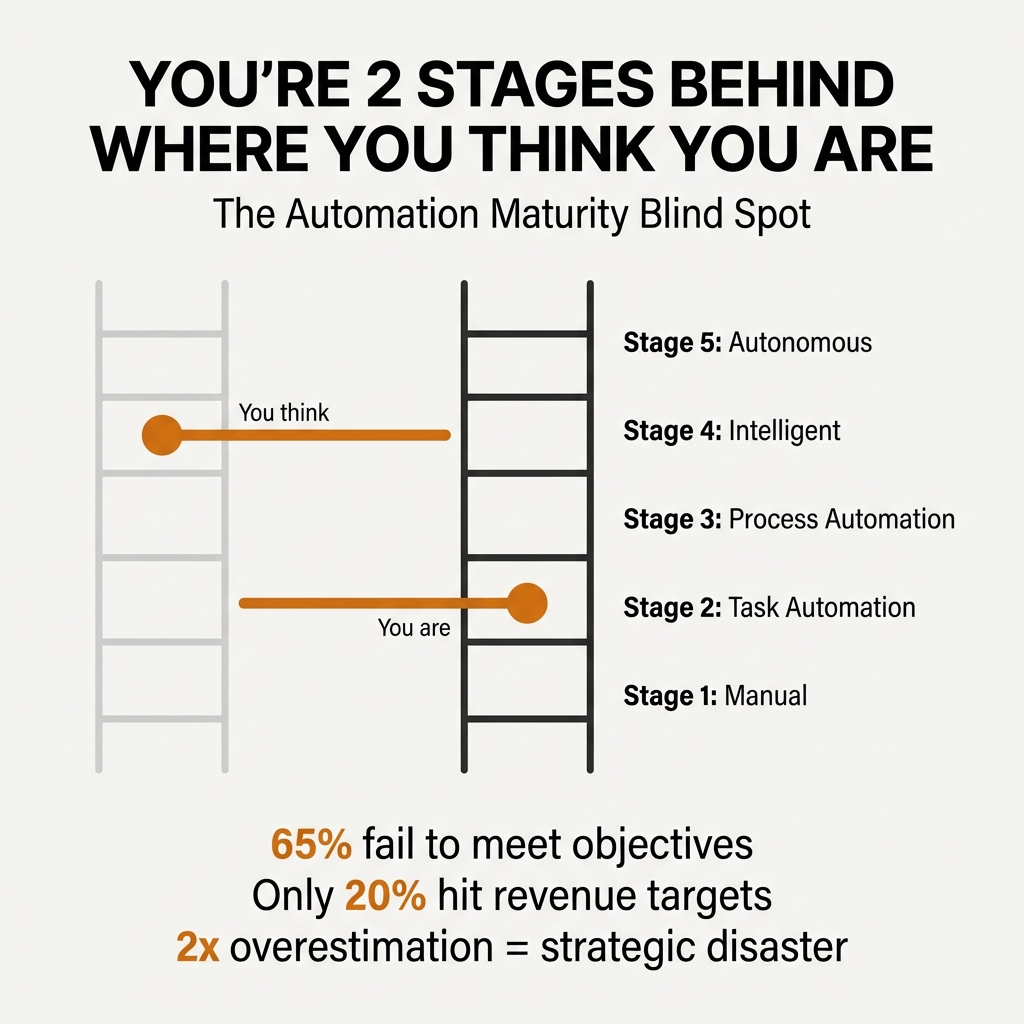
Leadership teams gather in conference rooms. They review their automation initiatives. They plot their position on maturity frameworks. And they get it wrong by roughly two full stages.
This isn't about optimism. It's about a systematic blind spot that costs companies millions in misallocated resources and missed opportunities.
The Overestimation Crisis
Organizations overestimate the value of their digital transformations by more than two times. That's not a rounding error. That's a strategic planning disaster.
The data reveals something troubling. Research shows a significant variance between how companies perceive their digital transformation maturity and what the actual requirements demand. Self-assessment inflates progress almost universally.
Here's what makes this dangerous:
The C-suite sees one reality. IT teams see another. Operations leaders see a third. Each group produces a different maturity score. None of them reflect what's actually happening on the ground.
You end up with a maturity assessment that measures opinion, not capability.
The Success Rate Reality Check
Only 35% of businesses accomplish their objectives related to digital transformation. That means 65% of companies are funding initiatives that won't deliver what they promised.
The numbers get worse when you look at specific outcomes.
A McKinsey study covering 600-plus firms found that only 20% achieved more than three-quarters of their anticipated revenue gains. Only 17% hit more than three-quarters of expected cost savings.
These aren't small misses. These are fundamental disconnects between perceived progress and actual results.
Understanding the Five-Stage Framework
Most automation maturity models break down into roughly five stages. The specifics vary, but the pattern holds.
Stage 1: Manual Everything
No automation. Processes run on spreadsheets, email chains, and tribal knowledge. Everyone knows they're here. This stage is hard to mistake.
Stage 2: Task Automation
You've automated individual tasks. Someone wrote a script. You bought a tool. Specific pain points get addressed in isolation.
This is where the perception gap starts to open.
Stage 3: Process Automation
Multiple tasks connect into automated workflows. You've moved beyond point solutions to integrated processes. Governance structures exist.
Most companies think they're here. Most companies are wrong.
Stage 4: Intelligent Automation
Automation includes decision-making logic. Systems adapt based on data. Machine learning enters the picture. The automation maintains itself to some degree.
Stage 5: Autonomous Operations
Self-optimizing systems. Automation that improves automation. Minimal human intervention required for routine operations.
Almost nobody operates here, despite what the case studies suggest.
Where Companies Actually Are
Organizations typically lack standards and governance at early maturity stages. They use untested automation code. They experience performance and reliability issues.
But they don't see themselves as early-stage.
I've watched companies with a handful of automated tasks describe themselves as having "mature automation practices." I've seen organizations with no governance framework claim they're ready for intelligent automation.
The pattern looks like this:
You automate a few processes. The automation works. Leadership celebrates the win. Someone creates a presentation showing "automation maturity" advancing.
Then you try to scale. That's when the gaps appear.
Organizations often start with overly ambitious automation roadmaps that prove difficult to execute at their actual phase of maturity. The result is early-stage stagnation dressed up as strategic planning.
The Self-Assessment Trap
Generic maturity models create this problem by design. They're self-scored, industry-agnostic, and lacking in actionable direction.
Most models function as self-scoring checklists. You mark what you think you've accomplished. The framework produces a score. That score inflates your actual position.
The blind spots this creates hinder meaningful progress in predictable ways.
You allocate resources based on where you think you are. Those resources target problems you don't actually have yet. Meanwhile, the foundational gaps that need attention remain unaddressed.
A structured self-assessment builds internal awareness. That has value. But pairing it with an external maturity assessment adds objectivity and validates findings in ways internal teams consistently miss.
The Technology Disconnect
More than half of companies struggle with inflexible technology platforms. Yet among successful transformations, two out of three invested in business-led, modern technology platforms to support scaling.
This reveals the disconnect between perceived and actual technological readiness.
You believe your technology stack can handle the next phase of automation. You've invested in tools. You've hired people who know how to use them.
Then you discover your platforms can't integrate the way you need them to. Your data architecture can't support the automation you planned. Your security model breaks under the new workflows.
The technology readiness you assumed doesn't exist.
The Market Reality
The global RPA market is growing at 24.20% annually. Over 60% of Fortune 500 enterprises have moved RPA beyond pilot stage into scaled deployment.
That sounds like widespread maturity.
But the reality is messier. Most organizations progress along multiple fronts simultaneously. They create complexity rather than linear advancement. They deploy tools without the governance to use them effectively.
Automation maturity has become a performance divider. Companies that accurately assess their position can allocate resources effectively. Companies that overestimate their maturity waste time and money solving the wrong problems.
How to Find Your Actual Position
Start by separating what you've deployed from what you've operationalized.
Deployment means you bought the tool and someone uses it. Operationalization means it's integrated, governed, and delivering consistent value at scale.
Most companies count deployments. Maturity requires operationalization.
Ask these questions:
- Can someone other than the creator maintain this automation?
- Do you have documentation that would allow recovery if the key person left?
- Does the automation have error handling and monitoring?
- Can you explain the business logic to someone outside your team?
- Do you have governance around changes and updates?
If you answer no to any of these, you're earlier stage than you think.
Look at your automation portfolio. Count how many automated processes exist. Then count how many have formal governance, documentation, and monitoring.
The gap between those numbers tells you something important about your actual maturity.
The Cost of Getting This Wrong
Overestimating your automation maturity creates specific, expensive problems.
You skip foundational work because you think you've already done it. You invest in advanced capabilities before you've mastered basic ones. You create technical debt that compounds over time.
Only 30% of digital transformations meet or exceed their target value and result in long-term change. The other 70% settle for diluted value and mediocre performance.
The difference often comes down to accurate self-assessment at the start.
Moving Forward
Understanding where you actually are doesn't mean abandoning ambition. It means investing in the right capabilities at the right time.
If you're honestly at Stage 2, build the governance and documentation that Stage 3 requires. If you're at Stage 3, develop the data architecture and decision frameworks that Stage 4 demands.
The companies that advance fastest aren't the ones with the most ambitious roadmaps. They're the ones who accurately diagnose their starting point and build systematically from there.
Your automation maturity matters less than your accuracy in assessing it.
Get that right, and everything else becomes easier.


Comments
Post a Comment