Marketing Automation Didn't Fail You—Your Human Bottlenecks Did
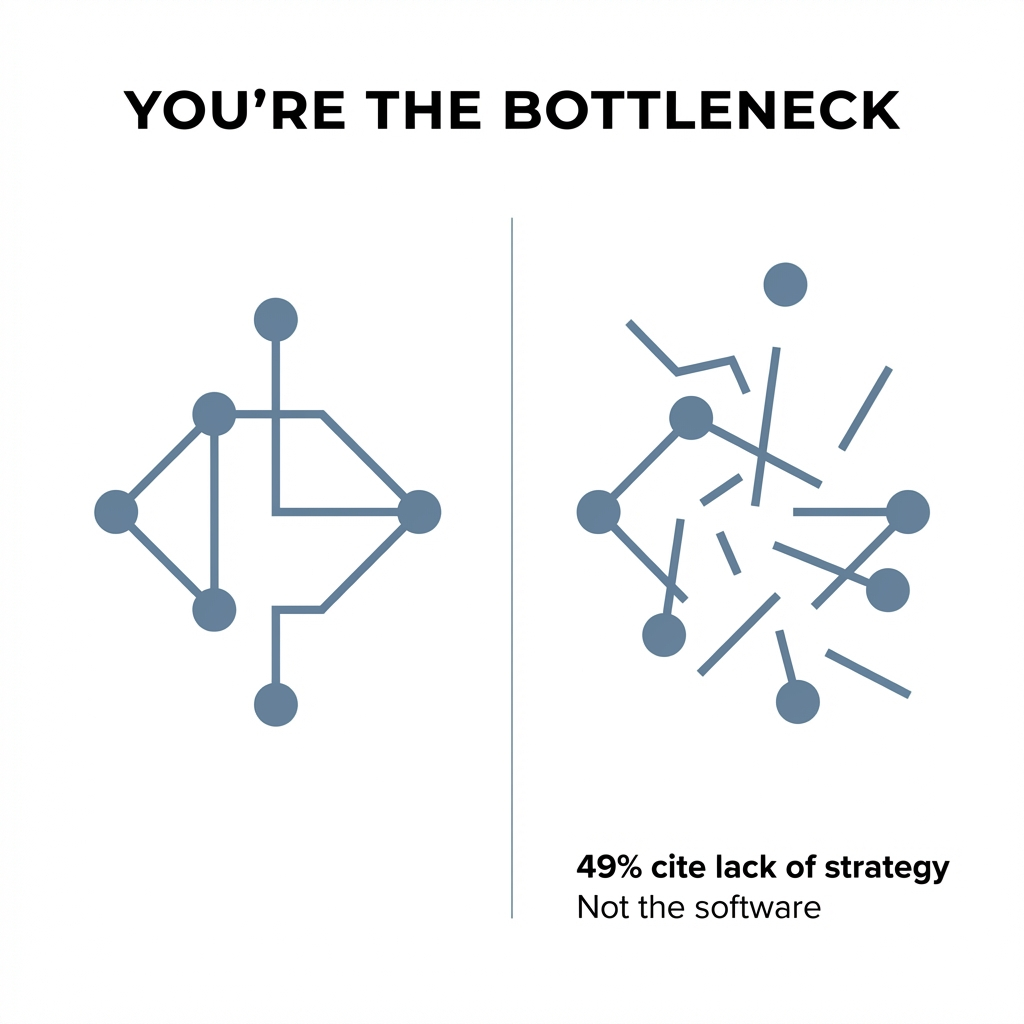
I've watched dozens of marketing teams blame their automation tools for poor results.
The CRM isn't working. The email platform is clunky. The analytics dashboard is confusing.
But here's what I've learned after years of investigating why marketing automation fails: the tools aren't the problem.
You are.
Before you close this tab, hear me out. I'm not saying you're incompetent or lazy. I'm saying you're human—and humans create bottlenecks that no amount of technology can fix.
The Real Culprit Behind Your Automation Failures
49% of B2B organizations cite the lack of an effective strategy as their biggest marketing automation challenge.
Not the software. Not the integrations. Not the user interface.
The strategy.
I've seen this pattern repeat itself across industries. A company invests six figures in a marketing automation platform, spends weeks implementing it, trains the team, and then... nothing happens.
Why? Because they automated a mess.
You can't automate your way out of strategic confusion. If you don't know who you're targeting, what message resonates, or how to move prospects through your funnel, automation just helps you fail faster.
The research backs this up. Knowledge gaps (71.7%), technical challenges (70%), and lack of training (67%) are the top failure factors for automation implementation.
Notice what's missing from that list? The technology itself.
The Content Creation Time Sink
Here's a stat that should make you uncomfortable: marketing teams waste an average of 12.7 hours per week re-prompting AI tools, tweaking outputs, and wrestling with inconsistent results.
That's nearly two full workdays lost to content struggles.
I've talked to content managers who spend more time fixing AI-generated drafts than they would have spent writing from scratch. They're caught in a cycle of prompt engineering, reviewing mediocre output, editing extensively, and then starting over when the result still doesn't match their brand voice.
The irony? Teams using structured workflows report producing publication-ready articles in just 9.5 minutes.
The difference isn't the AI tool. It's the human workflow design.
Most marketing teams rely on a small group of writers to produce all necessary content. When content demands scale, these writers become bottlenecks. Approvals pile up. Publication schedules slip. Campaign launches get delayed.
The automation platform sits there, ready to send perfectly timed emails to segmented lists. But there's no content to send.
Your Data Is Sabotaging Everything
Let me share something that might sting: marketing data quality issues cost organizations an average of $12.9 million annually.
Poor data is the silent killer of automation ROI.
I've reviewed marketing databases where 40% of email addresses were invalid, job titles were outdated, and company information was incomplete. Then the marketing team wondered why their carefully segmented campaigns performed poorly.
Garbage in, garbage out.
54% of businesses cite data quality and completeness as their largest marketing data management challenge. And here's the kicker: 60% of organizations report that human error and consistency are major data quality issues.
Your automation platform can't fix typos. It can't update outdated information. It can't merge duplicate records that your sales team created because they didn't check if the contact already existed.
Every automation workflow you build on top of bad data amplifies the problem. You're not personalizing emails—you're addressing people by the wrong name at scale. You're not targeting the right segments—you're excluding qualified prospects because their information is incomplete.
The technology works perfectly. Your data doesn't.
The Sales and Marketing Disconnect
Here's a stat that should keep CMOs awake at night: sales ignores up to 80% of marketing leads.
Instead, they spend half their time on unproductive prospecting.
I've sat in meetings where marketing proudly presents their lead generation numbers while sales rolls their eyes. The leads are "low quality," they say. They're "not ready to buy." They're "a waste of time."
Meanwhile, marketing blames sales for not following up fast enough, not using the nurture sequences, and not providing feedback on lead quality.
The research reveals that at least 25% of sales and marketing teams operate as independent, siloed departments. Only 17% report complete alignment.
Here's the perception gap that explains everything: 82% of C-level executives believe their teams are aligned. Only 35% of sales and marketing professionals agree.
Leadership thinks everything is fine. The people doing the work know it's broken.
Your marketing automation platform can score leads, trigger alerts, and route contacts to the right rep. But it can't fix the fundamental disconnect between two teams that don't trust each other's judgment.
Most sales collateral goes unused or underused by sales teams. Marketing creates assets with little input from sellers, then wonders why they sit in a shared drive gathering digital dust.
No automation tool can fix that.
Process Design Beats Technology Every Time
McKinsey research shows companies succeed when they redesign processes around AI—simply layering AI on existing systems rarely works.
I've watched organizations spend months implementing sophisticated marketing automation platforms, only to use them as glorified email schedulers.
Why? Because they didn't redesign their processes first.
The barriers preventing teams from using automation tools to their fullest potential are revealing:
35% cite lack of resources to manage
31% cite lack of training or knowledge
26% cite lack of budget to maintain
20% cite tools that don't integrate
Notice the pattern? Most of these are human and organizational factors.
You bought the tool. You didn't invest in the people, processes, and ongoing support needed to make it work.
I've seen marketing teams launch automation workflows without documenting them. Six months later, when someone leaves, nobody knows how the sequences work or where to update them. The workflows keep running, sending outdated information to prospects.
The technology is reliable. Your process documentation isn't.
The Hidden Tax of Manual Coordination
Content teams publishing at scale face a challenge most people don't see: the maze of manual coordination behind every post.
Chasing approvals through email threads. Reformatting assets. Scrambling when bottlenecks appear.
What should be streamlined becomes project management chaos.
I've talked to marketing managers who spend more time coordinating content production than actually creating strategy. They're tracking who reviewed what, following up on overdue approvals, and manually moving files between systems.
The research shows that teams spend up to 50% of their work hours manually verifying and correcting information. That's half your marketing team's time spent on data janitor work instead of optimization and strategy.
Your automation platform can't approve content. It can't make decisions about brand voice. It can't resolve conflicting feedback from stakeholders.
These human bottlenecks slow everything down.
What Happens When You Fix the Human Problems
Here's the good news: when you address the human factors, the results are dramatic.
Companies make $5.44 for every $1 spent on marketing automation—a 544% ROI. And 76% of companies see ROI within a year.
But only when they fix the strategic, data, and alignment issues first.
I've seen teams transform their results by focusing on the human elements:
They document their strategy before implementing tools. They know their customer journey, their messaging framework, and their conversion goals. The automation platform executes a clear plan instead of automating confusion.
They invest in content workflows, not just content tools. They build systems for consistent production, clear approval processes, and scalable quality control. The bottleneck disappears because the process supports the people.
They treat data quality as a continuous process. They assign ownership, create validation rules, and build regular cleanup into their workflow. The automation platform has good data to work with.
They align sales and marketing through shared definitions and regular communication. They agree on what makes a qualified lead, how quickly sales will follow up, and how marketing will support the sales process. The automation platform connects two teams that actually work together.
They redesign processes around the technology. They don't just implement tools—they change how work gets done. They train people, document workflows, and assign clear ownership. The automation platform becomes part of how the team operates, not a separate system they fight against.
The Uncomfortable Truth
Your marketing automation platform is probably fine.
You're the bottleneck.
Your lack of strategy. Your content production chaos. Your dirty data. Your misaligned teams. Your undocumented processes.
The technology is doing exactly what you told it to do. The problem is what you told it to do doesn't work.
I know this is hard to hear. It's easier to blame the tools than to acknowledge that your organization has fundamental problems that technology can't solve.
But here's the thing: recognizing the real problem is the first step to fixing it.
Stop asking your automation platform to do more. Start asking yourself why your team can't use what you already have.
The answer is usually staring back at you in the mirror.


Comments
Post a Comment