How I Evaluate Technical Debt in Marketing Systems (And Decide What to Fix First)
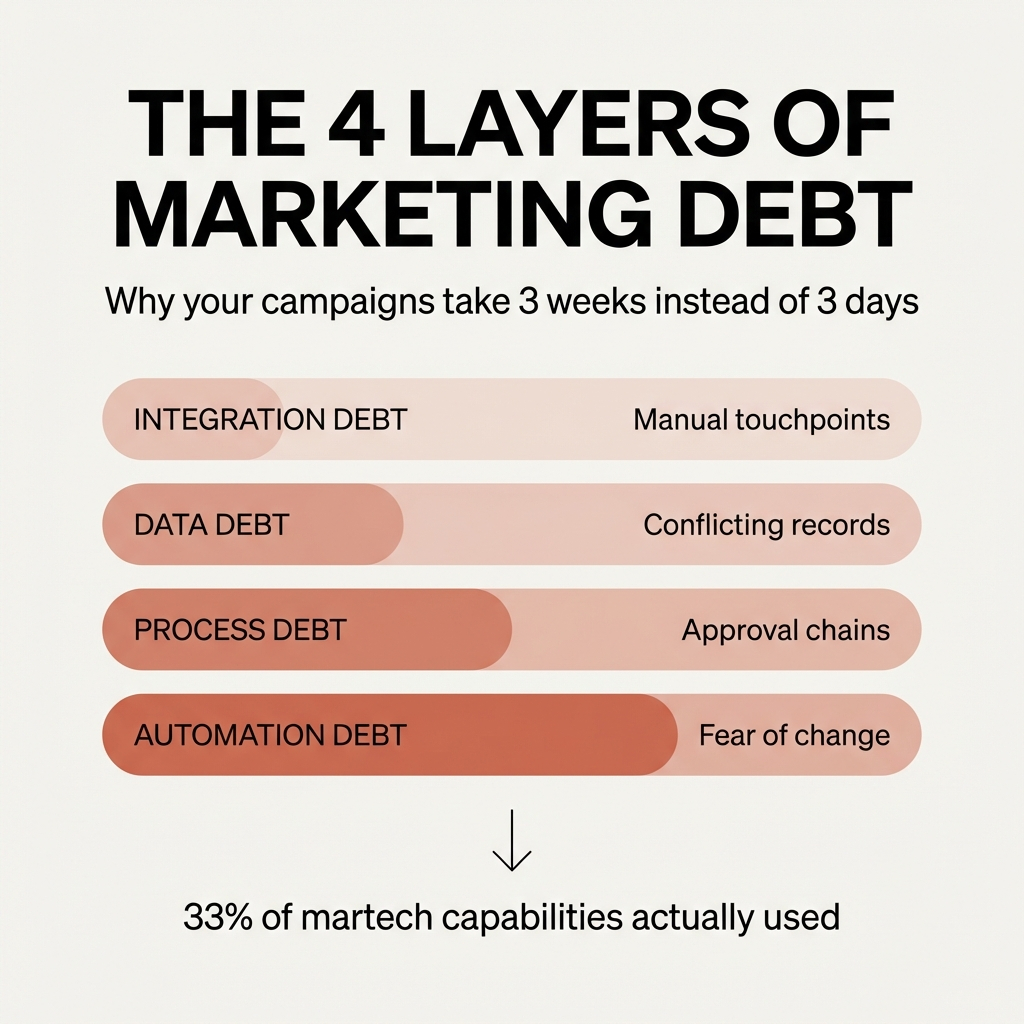
I've spent years watching marketing teams drown in their own infrastructure.
The problem isn't always obvious. Your campaigns still run. Your emails still send. Your analytics still report numbers. But underneath, the system groans under accumulated weight.
Technical debt in marketing systems looks different than in software development. You're dealing with process debt, integration debt, data debt, and automation debt all tangled together. Senior marketing leaders at Fortune 500 companies can't articulate the ROI of their martech investments. That's not a skills problem. That's a debt problem.
I've developed a mental model to see this debt clearly, measure its impact, and decide what to pay down first. Here's how I do it.
The Debt Becomes Visible When You Track Velocity
Most teams measure outputs. Campaigns launched. Emails sent. Reports generated.
I measure velocity instead.
How long does it take to go from idea to execution? If that timeline keeps stretching, you have debt. If your team needs three meetings and two weeks to launch what used to take two days, you're paying interest on accumulated complexity.
I track three velocity indicators:
- Time to launch — How long from decision to live campaign?
- Time to insight — How long from data collection to actionable analysis?
- Time to fix — How long to resolve a broken integration or workflow?
When these numbers trend upward over quarters, you're accumulating debt faster than you're paying it down.
The data backs this up. Organizations spend 30% of IT budgets managing technical debt. That's money you can't spend on innovation. That's capacity you can't deploy on growth.
I Map Debt Across Four Layers
Marketing system debt accumulates in predictable places. I look at four layers:
Integration Debt
You have 47 tools in your stack. Twelve of them talk to each other. The rest require manual data transfer, CSV exports, or "Bob remembers to update the spreadsheet every Monday."
Integration debt shows up as:
- Manual data entry between systems
- Duplicate records across platforms
- Broken API connections nobody fixed
- Workarounds that became permanent processes
I measure this by counting manual touchpoints per campaign. If launching one email requires touching five different systems and three spreadsheets, you're carrying heavy integration debt.
Data Debt
Your CRM has three email fields. Your marketing automation platform has two. Your analytics tool has four. None of them match. Nobody knows which one is correct.
Data debt includes:
- Inconsistent field definitions across systems
- Duplicate or conflicting records
- Unmapped or untagged historical data
- Custom fields nobody documented
I measure data debt by confidence in reporting. When your team prefaces every number with "well, it depends on how you count it," you have data debt.
Process Debt
You built a workflow three years ago. It made sense then. Now it has seventeen approval steps, four redundant reviews, and nobody remembers why.
Process debt looks like:
- Approval chains that slow everything down
- Redundant quality checks
- Processes designed around people who left
- Workarounds that became standard operating procedure
I measure this by tracking cycle time per process stage. Where does work sit waiting? That's where process debt lives.
Automation Debt
You automated something five years ago. It still runs. You're afraid to touch it because nobody knows how it works anymore.
Automation debt includes:
- Undocumented workflows and triggers
- Automations built on deprecated features
- Scripts maintained by people who left
- Systems running on "if it works, don't touch it" logic
The warning sign here is fear of change. When your team says "we can't update that because something might break," you're sitting on automation debt.
The Real Cost Shows Up in Utilization
Here's the number that matters: only 33% of martech capabilities get fully utilized.
You're paying for tools you barely use. You're maintaining integrations nobody needs. You're running processes that add no value.
I audit utilization by asking:
- What features do we actually use in each tool?
- What automations still serve their original purpose?
- What reports does anyone actually read?
- What processes could we skip without impact?
Low utilization isn't always debt. Sometimes you need capacity for future growth. But when you're using 30% of your stack and struggling to keep it running, you're maintaining debt instead of building capability.
How I Decide What to Pay Down First
You can't fix everything at once. I prioritize debt paydown using three criteria:
Impact on Velocity
What's slowing you down most? I look for the bottlenecks that affect multiple workflows. If fixing one integration eliminates manual work from ten different processes, that's high-impact debt.
I ask: What single change would speed up the most work?
Risk of Failure
Some debt is dangerous. Automations running on deprecated APIs. Integrations held together with duct tape. Data syncs that fail silently.
I prioritize debt that could break catastrophically. The stuff that keeps you up at night deserves attention before the stuff that just annoys you.
Cost to Carry
Some debt is expensive to maintain. Manual processes that consume hours every week. Tools you pay for but barely use. Workarounds that require constant attention.
I calculate cost to carry versus cost to fix. If you're spending ten hours a week maintaining a workaround, and you could fix it permanently in twenty hours, you break even in two weeks.
I Reserve Capacity for Debt Paydown
The research suggests reserving 15-25% of each sprint for debt reduction. I follow that framework.
Here's what that looks like in practice:
If your team has 100 hours of capacity per week, allocate 15-25 hours to debt paydown. Not "if we have time." Not "when things slow down." As a planned, protected allocation.
I track debt paydown the same way I track feature development:
- Identify the debt item
- Estimate effort to resolve
- Measure impact after resolution
- Document what you learned
Teams that treat debt paydown as optional never catch up. Teams that schedule it systematically start moving faster over time.
The 2026 Problem Makes This Urgent
Industry analysts predict 2026 as the year of technical debt. AI adoption is accelerating. Teams are adding new tools and automations without fixing the foundation.
You're building on top of debt. That makes everything more fragile.
75% of technology decision-makers will see their technical debt rise to moderate or high severity by 2026. Marketing systems are particularly vulnerable because they sit at the intersection of multiple platforms, data sources, and automation layers.
The time to address this is now. Before you add more complexity. Before the debt compounds further.
What Good Looks Like
Companies that optimize their martech stack achieve 20% higher ROI than competitors. That's the upside of systematic debt management.
When you pay down debt consistently, you see:
- Faster campaign launches
- More reliable data
- Fewer emergency fixes
- Higher team confidence
- Better resource utilization
You stop spending time maintaining complexity and start spending time creating value.
Start With Visibility
You can't manage what you can't see. Start by making your debt visible:
Track velocity metrics. Measure how long things take. Watch for trends.
Map your debt across the four layers. Integration, data, process, automation. Where does it live?
Calculate utilization. What are you actually using? What's just sitting there costing money?
Prioritize by impact, risk, and cost. What matters most? What's most dangerous? What's most expensive to carry?
Reserve capacity for paydown. Make it systematic. Make it protected.
The debt you ignore today becomes the crisis you manage tomorrow. The debt you address systematically becomes the foundation for faster, more reliable marketing operations.
I've seen teams transform their velocity by treating debt management as seriously as feature development. You can do the same.
The question isn't whether you have technical debt in your marketing systems. You do. The question is whether you can see it clearly enough to pay it down strategically.


Comments
Post a Comment